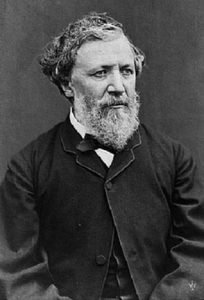
Biography
Robert Browning was born on May 7, 1812, in Camberwell (a suburb of London), the first child of Robert and Sarah Anna Browning. His mother was a fervent Evangelical and an accomplished pianist. Mr. Browning had angered his own father and forgone a fortune: the poet's grandfather had sent his son to oversee a West Indies sugar plantation, but the young man had found the institution of slavery so abhorrent that he gave up his prospects and returned home, to become a clerk in the Bank of England. On this very modest salary he was able to marry, raise a family, and to acquire a library of 6,000 volumes. He was an exceedingly well-read man who could recreate the seige of Troy with the household chairs and tables for the benefit of his inquisitive son.
Indeed, most of the poet's education came at home. He was an extremely bright child and a voracious reader (he read through all fifty volumes of the Biographie Universelle) and learned Latin, Greek, French and Italian by the time he was fourteen. He attended the University of London in 1828, the first year it opened, but left in discontent to pursue his own reading at his own pace. This somewhat idiosyncratic but extensive education has led to difficulties for his readers: he did not always realize how obscure were his references and allusions.
In the 1830's he met the actor William Macready and tried several times to write verse drama for the stage. At about the same time he began to discover that his real talents lay in taking a single character and allowing him to discover himself to us by revealing more of himself in his speeches than he suspects-the characteristics of the dramatic monologue. The reviews of Paracelsus (1835) had been mostly encouraging, but the difficulty and obscurity of his long poem Sordello (1840) turned the critics against him, and for many years they continued to complain of obscurity even in his shorter, more accessible lyrics.
Read the full biography
In 1845 he saw Elizabeth Barrett's Poems and contrived to meet her. Although she was an invalid and very much under the control of a domineering father, the two married in September 1846 and a few days later eloped to Italy, where they lived until her death in 1861. The years in Florence were among the happiest for both of them. Her love for him was demonstrated in the Sonnets from the Portugese, and to her he dedicated Men and Women, which contains his best poetry. Public sympathy for him after her death (she was a much more popular poet during their lifetimes) surely helped the critical reception of his Collected Poems (1862) and Dramatis Personae (1863). The Ring and the Book (1868-9), based on an "old yellow book" which told of a Roman murder and trial, finally won him considerable popularity. He and Tennyson were now mentioned together as the foremost poets of the age. Although he lived and wrote actively for another twenty years, the late 1860s were the peak of his career. His influence continued to grow, however, and finally lead to the founding of the Browning Society in 1881. He died in 1889, on the same day that his final volume of verse, Asolando, was published. He is buried in Poet's Corner of Westminster Abbey.
Biography by Glenn Everett, Associate Professor of English, University of Tennessee at Martin
On Porphyria's Lover
On My Last Duchess
On Meeting At Night
On Parting At Morning
On Prospice
On The Patriot