Biography
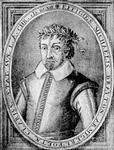
Michael Drayton (1563- December 23, 1631) was an English poet who came to prominence in the Elizabethan era.
He was born at Hartshill, near Atherstone, Warwickshire. Even in childhood he showed some poetic ambition. At the age of ten he found a position as a pageboy, and a little later he is thought to have studied at the University of Oxford. Sir Henry Goodere of Powlesworth became his patron, and introduced him to the Countess of Bedford. For several years he was esquire to Sir Walter Aston. Nothing else is known about his youth, though it has been surmised that he served in the army abroad. In 1590 he seems to have settled in London.
In 1591 he produced his first book, The Harmony of the Church, a volume of spiritual poems, dedicated to Lady Devereux. The It is notable for a version of the Song of Solomon, executed with considerable richness of expression. However, with the exception of forty copies, seized by the Archbishop of Canterbury, the whole edition was destroyed by public order. Nevertheless, Drayton published a vast amount within the next few years.
Read the full biography
In 1593 appeared Idea: The Shepherd's Garland, a collection of nine pastorals, in which he celebrated his own love-sorrows under the poetic name of Rowland. The basic idea was expanded in a cycle of 64 sonnets, published in 1594, under the title of Idea's Mirror, by which we learn that the lady lived by the river Ankor in Warwickshire. It appears that he failed to win his "Idea," and lived and died a bachelor. In 1593 appeared the first of Drayton's historical poems, The Legend of Piers Gaveston, and the next year saw the publication of Matilda, an epic poem in rhyme royal. It was about this time, too, that he brought out Endimion and Phoebe, a volume which he never republished, but which contains some interesting autobiographical matter, and acknowledgments of literary help from Thomas Lodge, if not from Edmund Spenser and Samuel Daniel also. In his Fig for Momus, Lodge reciprocated these friendly courtesies.
In 1596 Drayton published his long and important poem of Mortimerades, which deals with the Wars of the Roses and is a very serious production in ottava rima. He later enlarged and modified this poem, and republished it in 1603 under the title of The Barons' Wars. In 1596 also appeared another historical poem, The Legend of Robert, Duke of Normandy, with which Piers Gaveston was reprinted. In 1597 appeared England's Heroical Epistles, a series of historical studies, in imitation of those of Ovid. These last poems, written in the heroic couplet, contain some of the finest passages in Drayton's writings.
By the year 1597, the poet was resting on his laurels. It seems that he was much favoured at the court of Elizabeth, and he hoped that it would be the same with her successor. But when, in 1603, he addressed a poem of compliment to James I, on his accession, it was ridiculed, and his services rudely rejected. His bitterness found expression in a satire, The Owl (1604), but he had no talent in this kind of composition. Not much more entertaining was his scriptural narrative of Moses in a Map of his Miracles, a sort of epic in heroics printed the same year. In 1605 Drayton reprinted his most important works, that is to say, his historical poems and the Idea, in a single volume which ran through eight editions during his lifetime. He also collected his smaller pieces, hitherto unedited, in a volume undated, but probably published in 1605, under the title of Poems Lyric and Pastoral; these consisted of odes, eclogues, and a fantastic satire called The Man in the Moon. Some of the odes are extremely spirited. In this volume he printed for the first time the famous Ballad of Agincourt.
He had adopted as early as 1598 the extraordinary resolution of celebrating all the points of topographical or antiquarian interest in the island of Great Britain, and on this laborious work he was engaged for many years. At last, in 1613, the first part of this vast work was published under the title of Poly-Olbion, eighteen books being produced, to which the learned Selden supplied notes. The success of this great work, which has since become so famous, was very small at first, and not until 1622 did Drayton succeed in finding a publisher willing to undertake the risk of bringing out twelve more books in a second part. This completed the survey of England, and the poet, who had hoped "to crown Scotland with flowers," and arrive at last at the Orcades, never crossed the Tweed.
In 1627 he published another of his miscellaneous volumes, and this contains some of his most characteristic and exquisite writing. It consists of the following pieces: The Battle of Agincourt, an historical poem in ottava rima (not to be confused with his ballad on the same subject), and The Miseries of Queen Margaret, written in the same verse and manner; Nimphidia, the Court of Faery, a most joyous and graceful little epic of fairyland; The Quest of Cinthia and The Shepherd's Sirena, two lyrical pastorals; and finally The Moon Calf, a sort of satire. Of these Nimphidia is perhaps the best thing Drayton ever wrote, except his famous ballad on the battle of Agincourt; it is quite unique of its kind and full of rare fantastic fancy.
The last of Drayton's voluminous publications was The Muses' Elizium in 1630. He died in London, was buried in Westminster Abbey, and had a monument placed over him by the Countess of Dorset, with memorial lines attributed to Ben Jonson. Drayton was a friend of some of the most famous men of the age. He corresponded familiarly with Drummond; Ben Jonson, William Browne, George Wither and others were among his friends. There is a tradition that he was a friend of William Shakespeare, supported by a statement of John Ward, once vicar of Stratford-on-Avon, that "Shakespear, Drayton and Ben Jonson had a merry meeting, and it seems, drank too hard, for Shakespear died of a feavour there contracted." In one of his poems, an elegy or epistle to Mr Henry Reynolds, he has left some valuable criticisms on poets whom he had known. He was even engaged in the labour of the dramatists; at least he had a share, with Munday, Chettle and Wilson, in writing Sir John Oldcastle, which was printed in 1600. That he was a restless and discontented, as well as a worthy, man may be gathered from his own admissions.
The works of Drayton are bulky, and, in spite of the high place that he holds in critical esteem, it cannot be pretended that he is much read. For this his ponderous style is much to blame. The Poly-Olbion, the most famous but far from the most successful of his writings, is difficult and barren in the extreme. It was, he tells us, a "Herculean toil" to him to compose it, and we are conscious of the effort. The metre in which it is composed, a couplet of alexandrines, like the French classical measure, is wholly unsuited to the English language, and becomes excessively wearisome to the reader, who forgets the learning and ingenuity of the poet in labouring through the harsh and overgrown lines. His historical poems, which he was constantly rewriting and improving, are much more interesting, and often rise to a true poetic eloquence.
His pastorals are brilliant, but overladen with colour and sweet to insipidity. He is, with the one magnificent exception. of "Since there's no help, come let us kiss and part," which was first printed in 1619, an indifferent sonneteer. The poet with whom it is most natural to compare him is Daniel; he is more rough and vigorous, more varied and more daring than the latter, but Daniel surpasses him in grace, delicacy and judgment. In their elegies and epistles, however, the two writers frequently resemble each other. Drayton, however, approaches the very first poets of the Elizabethan era in his charming Nimphidia, a poem which inspired Herrick with his sweet fairy fancies and stands alone of its kind in English literature; while some of his odes and lyrics are inspired by noble feeling and virile imagination.
In 1748 a folio edition of Drayton's complete works was published under the editorial supervision of William Oldys, and again in 1753 there appeared an issue in four volumes. But these were very unintelligently and inaccurately prepared. A complete edition of Drayton's works with variant readings was projected by Richard Hooper in 1876, but was never carried to a conclusion; a volume of selections, edited by AH Bullen, appeared in 1883. See especially Oliver Elton, Michael Drayton (1906).
This entry was originally from the 1911 Encyclopedia Britannica.
This article is licensed under the GNU Free Documentation License and uses material adapted in whole or in part from the Wikipedia article on Michael Drayton.
On Sonnet LXI: Since There's No Help